It started with a military blueprint and a single demand: build something that doesn’t break.
No sketches for showroom appeal. No glossy pitch to executives. Just an order to design a vehicle that could take punishment in deserts, mountains, and frozen outposts and keep going. Out of that order came the Mercedes G-Wagon SUV, a machine born from function and hardened by necessity.
More than forty years later, its silhouette still carries the same commanding stance. The lines may wear chrome now, and the cabin may be lined with leather, but the soul hasn’t shifted. Underneath lies the original off-road hardware and the same go-anywhere instinct that once made it indispensable in uniform.
That unshakable character is why the G-Wagon earns respect on any road it drives.
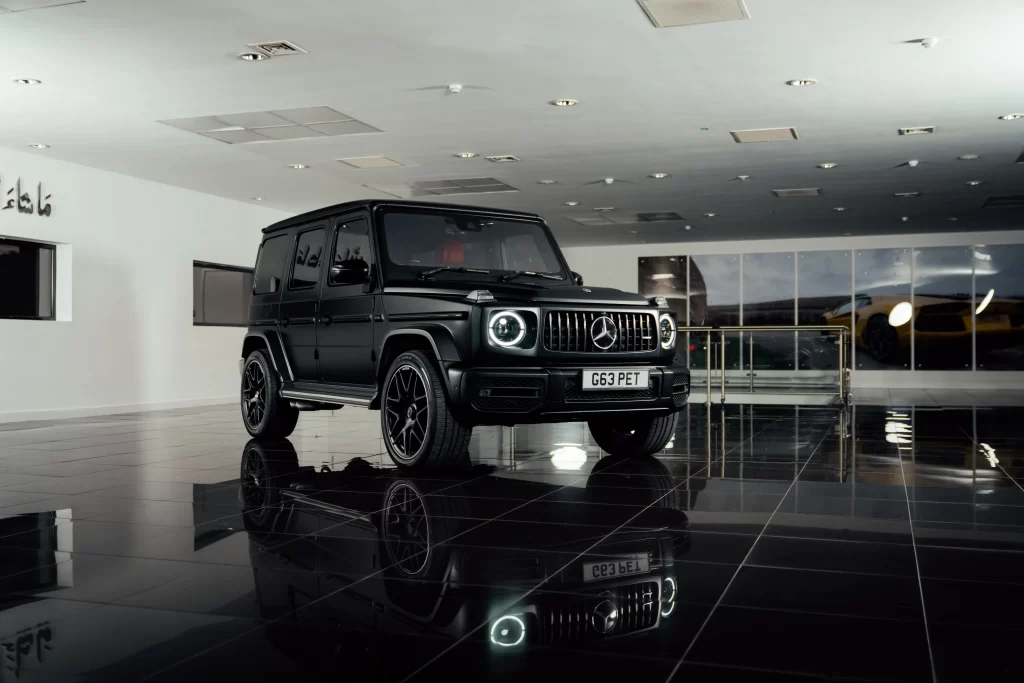
The origin story: Built for battle, refined for the road
In 1972, Daimler-Benz partnered with Austrian manufacturer Steyr-Daimler-Puch to develop a new all-terrain vehicle, a project inspired by the Shah of Iran, then a major Mercedes shareholder, who wanted a machine that could thrive in the harshest environments.
The prototypes were tested far beyond safe proving grounds. They crossed the burning Sahara, endured the Arctic Circle, and climbed unforgiving alpine terrain. One of the earliest design studies was even a full-scale wooden mock-up, built to perfect proportions before the first steel prototype rolled out. Every stage of development focused on endurance, not aesthetics.
By 1979, the first civilian G-Class emerged from the production line in Graz, Austria. It carried the same uncompromising engineering intended for military use, which quickly won over people who needed true off-road reliability. Through the 1980s and ’90s, the G-Class evolved, shifting from working vehicle to luxury symbol, yet its rugged core never changed.
Defining traits of the first G-Class:
- Ladder-frame chassis for uncompromising strength
- Permanent four-wheel drive
- Three fully locking differentials, almost unheard of at the time, and still uncommon among modern 4x4s
- Simple mechanical layout for easy repairs in the field
Today, every G-Class is still hand-built in Graz and driven across a dedicated on-site off-road test track before delivery. The interiors may now feature advanced technology and refined materials, but the foundation remains the same: durability first, luxury second.
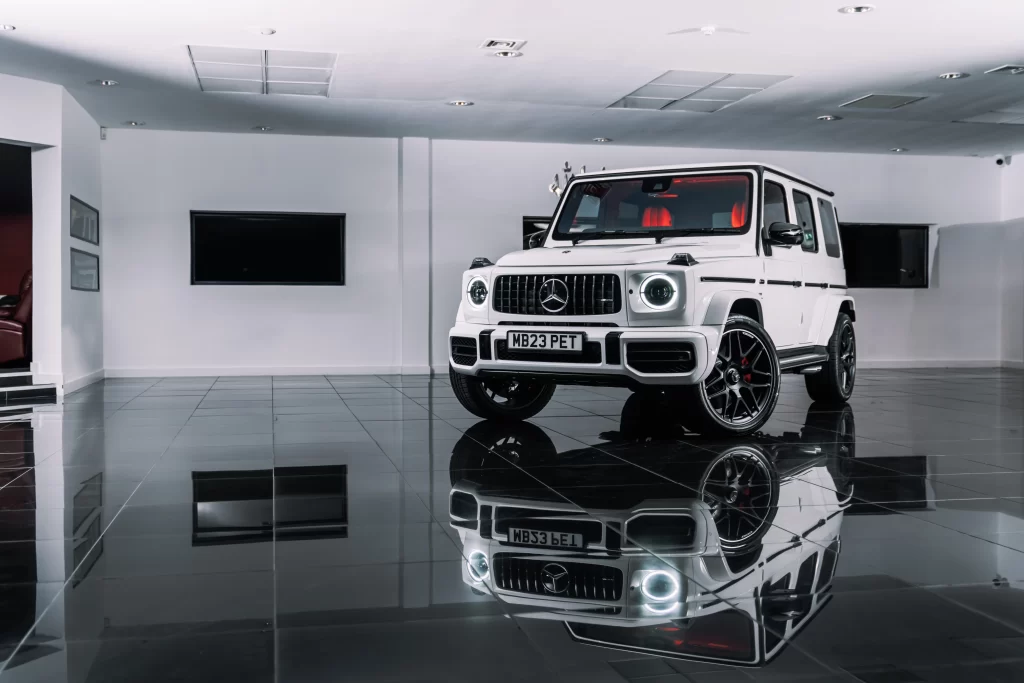
Why the G-Wagon still sets the standard
Unlike many luxury SUVs that simulate ruggedness with electronics, the Mercedes-Benz G-Class (“G-Wagon”) is built on proven mechanical systems, with roots in decades of military-tested engineering. Here’s what sets it apart:
1. Three locking differentials
Every modern G-Class (W463) comes with three locking differentials: front, centre, and rear. This setup is rare; most 4×4 SUVs only offer one or two, if any. With all three engaged, the G-Wagon can keep moving even if just a single wheel has traction.
2. Ladder-frame chassis
All G-Class models are built on a ladder-frame chassis (body-on-frame), unlike the unibody construction found in most SUVs. This design makes the G-Class:
- Stronger and more flexible off-road
- Easier to repair in remote conditions
It’s one of the reasons G-Class variants have remained in service with militaries and organisations like the UN.
3. Low-range gearbox
Every gasoline and AMG G-Class comes with a low-range transfer case. This allows slow-speed crawling with maximum torque, making it possible to climb steep slopes, cross rocks, or push through deep mud and sand.
4. Off-road geometry & ground clearance
The numbers vary by version:
Standard G-Class (2019–2024: G 550, AMG G 63)
- Ground clearance: 241 mm (9.5 in)
- Approach angle: 31°
- Departure angle: 30°
- Breakover angle: 26°
G 500 / G 550 4×4² (Portal Axles, 2017)
- Ground clearance: 438 mm (17.2 in)
- Approach angle: 51.6°
- Departure angle: 43.8°
- Breakover angle: 47.4°
AMG G 63 4×4² (Portal Axles, 2022–2024)
- Ground clearance: 350.5 mm (13.8 in)
- Approach angle: 45°
- Departure angle: 36.8°
- Breakover angle: 42°
5. Deep-Water Capability (Fording Depth)
- Standard G-Class (e.g. G 550, AMG G 63): 700 mm (27.6 in)
- G 63 4×4² (portal axle variant): ~910 mm (35.8 in)
- G 63 AMG 6×6 (limited production): ~1,000 mm (39.4 in)*
All standard G-Class models are rated to safely ford up to 700 mm of water, one of the best in the luxury SUV class. The rare 4×4² and ultra-limited 6×6 push that capability even further, approaching a full metre in depth.
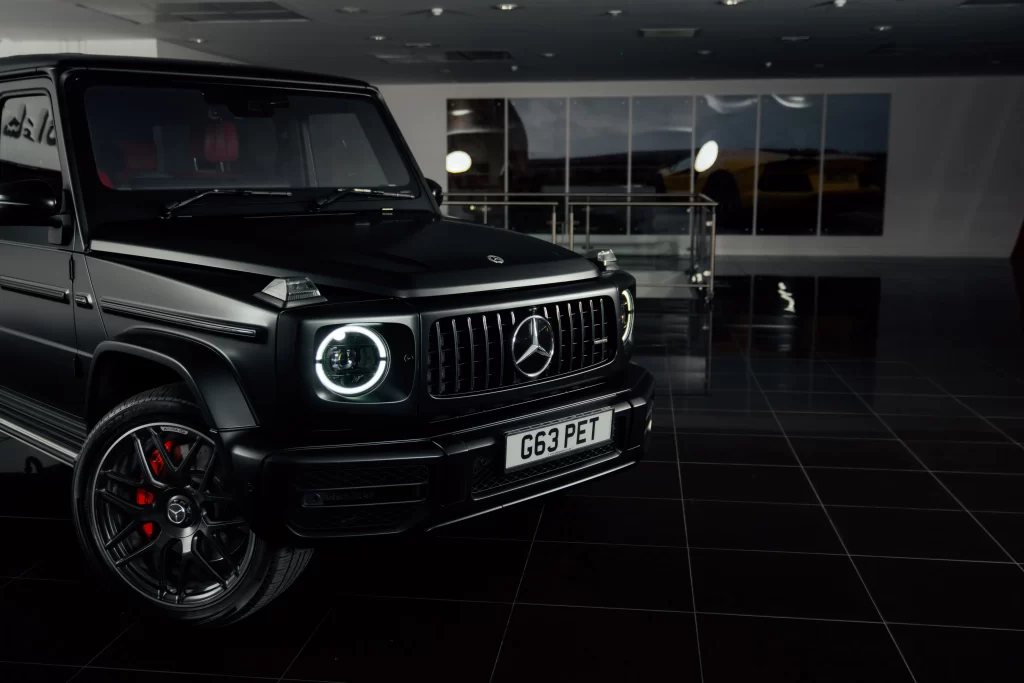
Smart driving technology in the G-Wagon
The G-Wagon’s core remains mechanical, but today’s electronics refine how it behaves on every surface.
1. Dynamic select drive modes
A rotary controller on the centre console lets drivers switch among several drive profiles:
- Comfort: relaxed, smooth driving
- Sport: sharper throttle and handling
- ECO: tuned for efficiency
- Off-road modes (trail, sand, rock): adapt drivetrain and suspension for rough terrain
- Individual: custom settings chosen by the driver
2. G-Mode off-road calibration
When the low range or a differential lock is engaged, G-Mode activates automatically. It fine-tunes suspension damping, steering, and throttle response to maximise stability and control on rough ground.
3. Off-road telemetry (optional off-road package)
With the optional Off-Road Package, the digital display becomes an OFFROAD COCKPIT®. It shows slope and tilt angles, compass direction, altitude, steering angle, torque distribution, and tyre pressures. From 2025 onward, this package can also include a “Transparent Hood” camera view that reveals obstacles hidden beneath the front of the vehicle.
4. Driver assistance systems
Modern G-Wagons come with a suite of safety technologies, including:
- Forward Collision Warning with Automatic Braking
- Blind-Spot Assist
- Lane-Keeping Assist
- Adaptive Cruise Control (optional)
- Crosswind Assist (available in some markets)
5. Connected cabin
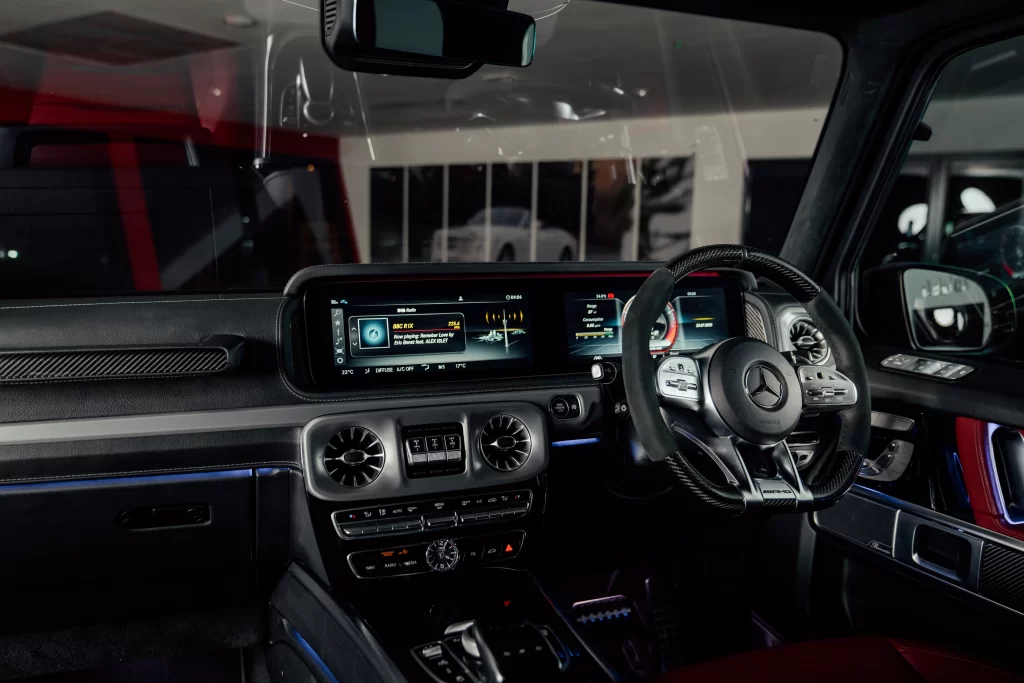
Inside, the G-Wagon features a widescreen digital cockpit with two displays: one for driving data and one for infotainment. Powered by Mercedes’ MBUX system, it can be controlled by touch, voice, or the centre console touchpad, combining convenience with focus on the road.
Real-world use cases of the Mercedes G-Wagon SUV
Military & peacekeeping
Originally developed with military input, the G-Class quickly proved itself in service. The 250 GD “Wolf” variant served the German Bundeswehr for decades, and many nations still operate G-Wagons for patrol and liaison duties.
The United Nations has also widely deployed them in peacekeeping missions, where rugged ladder-frame construction, high clearance, and ease of repair make them valuable in unstable regions with rough terrain.
Search and rescue
In the Swiss and Austrian Alps, rescue teams use modified G-Wagons to reach areas that ordinary vehicles cannot. Strong traction, powerful low-range gearing, and reliable cold-weather performance make it effective on snow, ice, and steep mountain terrain.
Armoured security & diplomatic transport
Specialist firms such as Brabus INVICTO, Alpine Armouring, and INKAS convert the G-Class into armoured SUVs with protection levels up to B6/B7.
These versions can withstand rifle fire and certain explosive threats, making them a trusted choice for diplomats, VIPs, and private security convoys. They combine ballistic protection with full off-road performance and luxury interiors.
Luxury safari vehicles
In destinations like Dubai, travel companies offer desert safaris using G-Wagons. The vehicles handle deep sand and dunes with ease while providing passengers with air-conditioned comfort and luxury interiors, setting them apart from standard off-road tour vehicles.
Why it’s still hand-built in Graz, Austria
Every Mercedes-Benz G-Class (G-Wagon) is still built by hand at the Magna Steyr factory in Graz, Austria.
Production has remained there since 1979, not just out of tradition, but because the vehicle’s design makes hand assembly essential.
Hand assembly vs. Mass production
Most SUVs are built on fast, automated assembly lines.
The G-Wagon is different: it uses a body-on-frame chassis and advanced off-road hardware that require precise manual fitting and calibration.
Instead of rolling down a single conveyor belt, each vehicle goes from one skilled team to the next: mechanics, electricians, upholsterers, and quality inspectors, ensuring exacting standards at every stage.
Off-road testing before delivery
Every G-Class is tested on the Schöckl mountain course near Graz before leaving the factory.
Engineers drive it up steep slopes, through water, and across uneven terrain, confirming drivetrain, electronics, and bodywork perform as intended. Few other production cars undergo this type of real-world trial.
Production numbers and rare editions
Since 1979, Mercedes-Benz has built more than 500,000 G-Wagons in Graz. Among the rarest are:
- 2002 G 63 AMG V12, produced in extremely limited numbers, making it one of the rarest G-Class models ever.
- 2024 “Stronger Than Diamonds” edition, 300 units worldwide, each with a 0.25-carat lab-grown diamond set into its door lock pins.
Who hires the Mercedes G-Wagon SUV?
1. Making an entrance
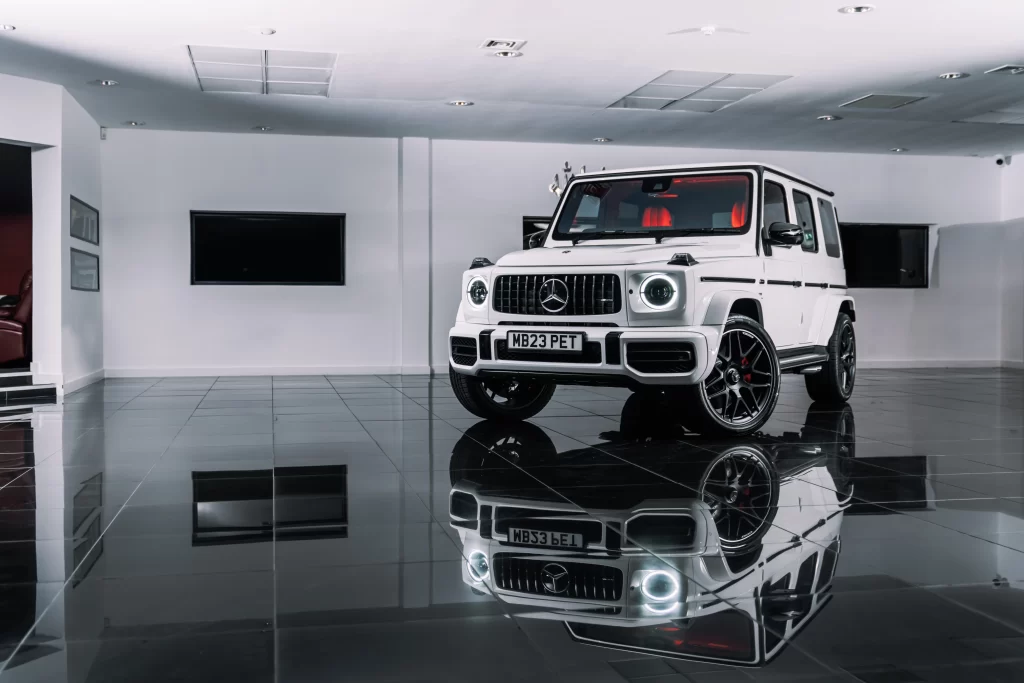
For weddings, proms, and major events, the G-Wagon makes a statement like few other vehicles. Its bold design and commanding road presence ensure all eyes are on you the moment you arrive.
2. Luxury and comfort
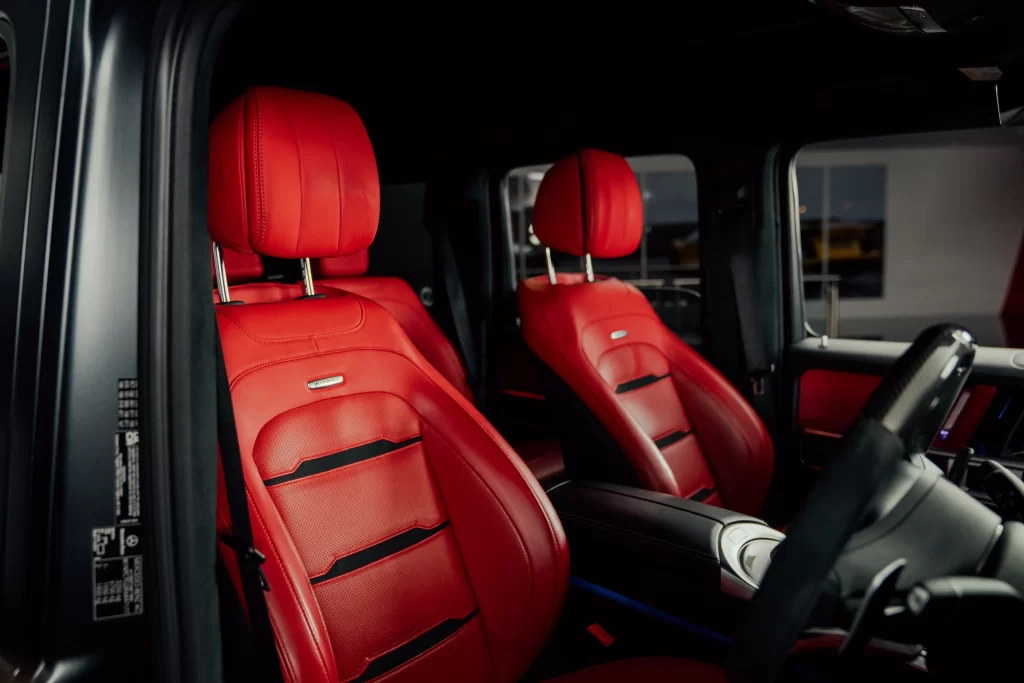
Many clients book the G-Wagon for its handcrafted interior, premium leather, and advanced technology. It delivers modern comfort while retaining the toughness of a true off-roader.
3. Performance enthusiasts
With nearly 580 horsepower from its AMG V8 engine, the G-Wagon attracts drivers who want more than style. It offers speed, power, and the thrill of commanding a performance SUV.
4. VIPs and professionals
Executives, celebrities, and high-profile guests often choose the G-Wagon as a symbol of status and success. It combines prestige with practicality and an added sense of security.
Experience the G-Wagon
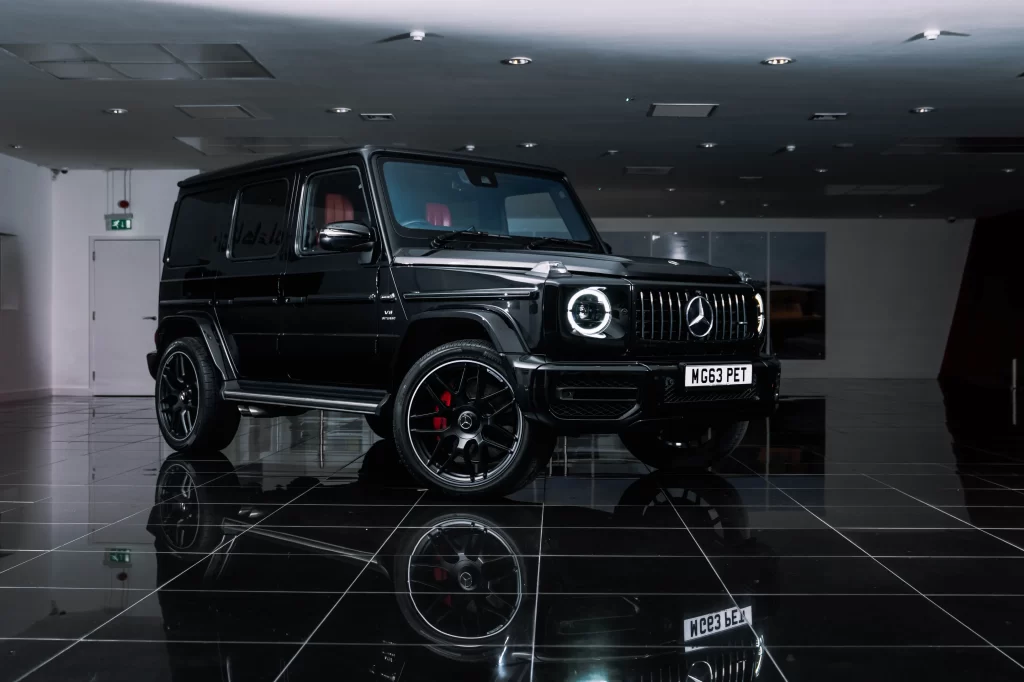
From military beginnings to modern luxury, the Mercedes-Benz G-Class has become one of the most recognised SUVs in the world. Its blend of power, engineering, and prestige makes it a standout on any occasion.
At Platinum Executive Travel, we offer the Mercedes-AMG G63 for hire across the UK, available for weddings, VIP events, corporate occasions, productions, and private use, with the choice of self-drive or chauffeur service.
Book your Mercedes-AMG G63 with Platinum Executive Travel today.
FAQs
Q1: What is the “Wolf” variant?
The “Wolf” is the military version of the Mercedes-Benz G-Class, most notably the 250 GD supplied to the German Bundeswehr. It’s a stripped-down, rugged model designed for durability and ease of repair in field conditions.
Q2: Is there an electric G-Wagon?
Yes. The G-Wagon now has an all-electric version called the Mercedes-Benz G 580 with EQ Technology. Launched in early 2025, it keeps the classic G-Class design while adding a quad-motor setup for advanced off-road control and features like the “G-Turn,” which allows it to spin in place. It is very new, so hiring availability is limited.
Q3: Is the G-Wagon fuel-efficient?
No. The G-Wagon is a large, powerful SUV, and fuel economy is not its strength. Newer models are more efficient than older versions, but even the current AMG G 63 averages only around 13–15 mpg (US)
Q4: Can the G-Wagon really go off-road better than other luxury SUVs?
Yes. With three locking differentials, a ladder-frame chassis, low-range gearing, and high ground clearance, the Mercedes G Wagon SUV outperforms most other luxury models in demanding off-road conditions.
Q5: How should I prepare when hiring a G-Wagon for serious off-roading?
If you’re hiring a G-Wagon for off-road use, it’s worth checking that the car is set up properly for the terrain. Make sure the tyres, suspension, and any recovery gear are suitable, and confirm that the vehicle has been well-maintained.
Q6. What occasions can I hire the Mercedes G-Wagon SUV for?
You can hire the G-Wagon for weddings, VIP events, music videos, photoshoots, corporate occasions, or even for a weekend self-drive. We offer flexible hire options and can deliver the vehicle anywhere in the UK, or you can collect it directly from our Birmingham showroom.