Quick look
The Lamborghini Huracán Evo Spyder sound comes from four things working together: a naturally aspirated 5.2-litre V10 with no turbochargers to muffle it, a split-pin crankshaft giving even 72-degree firing intervals, an equal-length exhaust with active valves, and an open roof that puts you inside the acoustics rather than behind them.
Before you even touch the accelerator, the Lamborghini Huracán Evo Spyder reveals its true nature, giving you an immediate sense of the incredible performance waiting beneath the surface. The moment the V10 roars to life, a surge of sound and energy fills the air, offering a preview of the power that lies within.
Designed to engage every sense, the Evo Spyder blends cutting-edge engineering, aerodynamics, and the unique thrill of open-air driving into an experience you feel from the first moment. With the roof down, the V10’s presence becomes more defined, allowing its character to reach the cabin with greater clarity.
In this blog, we’ll dive into the engineering and physics behind this iconic sound and explore why the Huracán Evo Spyder’s symphony is as integral to its performance as its power and agility.
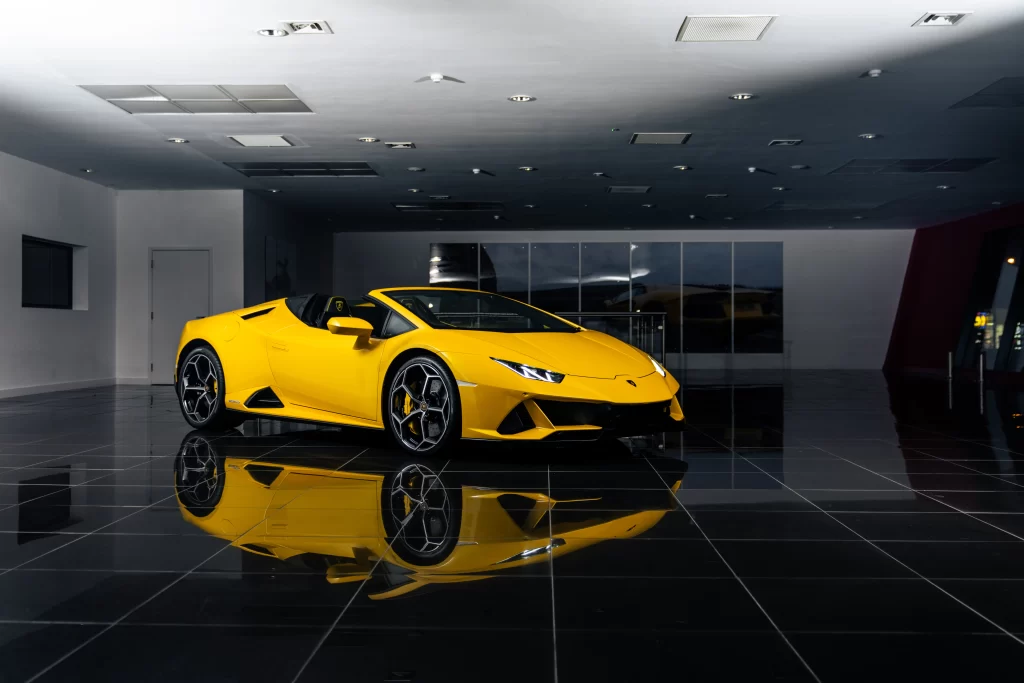
Why does a naturally aspirated V10 sound different?
The Huracán Evo Spyder stays true to Lamborghini’s heritage with its naturally aspirated 5.2-litre V10 engine, an increasingly rare setup in a world shifting toward turbocharging. Without forced induction altering airflow, the V10 delivers its sound in a clean, unfiltered form shaped directly by combustion, air intake and exhaust flow.
- No turbochargers interrupt the natural frequencies produced by combustion.
- The intake system sits close to the cabin, giving the lower frequencies a distinctive presence.
- Immediate throttle response produces instant changes in tone.
- Free-breathing operation allows the engine’s full acoustic personality to develop across the rev range.
The contrast is easiest to hear against the Urus, which uses a twin-turbo V8. We have traced that shift in Lamborghini’s move from V12 to turbocharged V8.
How does the firing order shape the note?
The Huracán Evo Spyder’s 5.2-litre V10 uses a 90-degree V angle and a split-pin crankshaft to achieve evenly spaced 72-degree firing intervals. This precise firing sequence shapes the engine’s tone.
- Even intervals create a firm, steady pulse that grows sharper as revs increase.
- The clean rhythm makes the sound easy to follow through the chassis.
- Throttle inputs shift pitch immediately.
As the V10 moves from 3,000 to 8,500 rpm, the tone follows a smooth, predictable climb.
What does the exhaust design add?
The Evo Spyder’s exhaust system is designed to deliver clarity and character. Equal-length runners, large pipes and active valves work together to create a balanced, purposeful sound.
- The Spyder’s short exhaust routing gives the car a direct, responsive voice.
- Equal-length runners allow exhaust pulses to travel evenly.
- Large-diameter pipes help preserve depth and richness.
- Active valves open wider in Sport and Corsa, sharpening the exhaust tone.
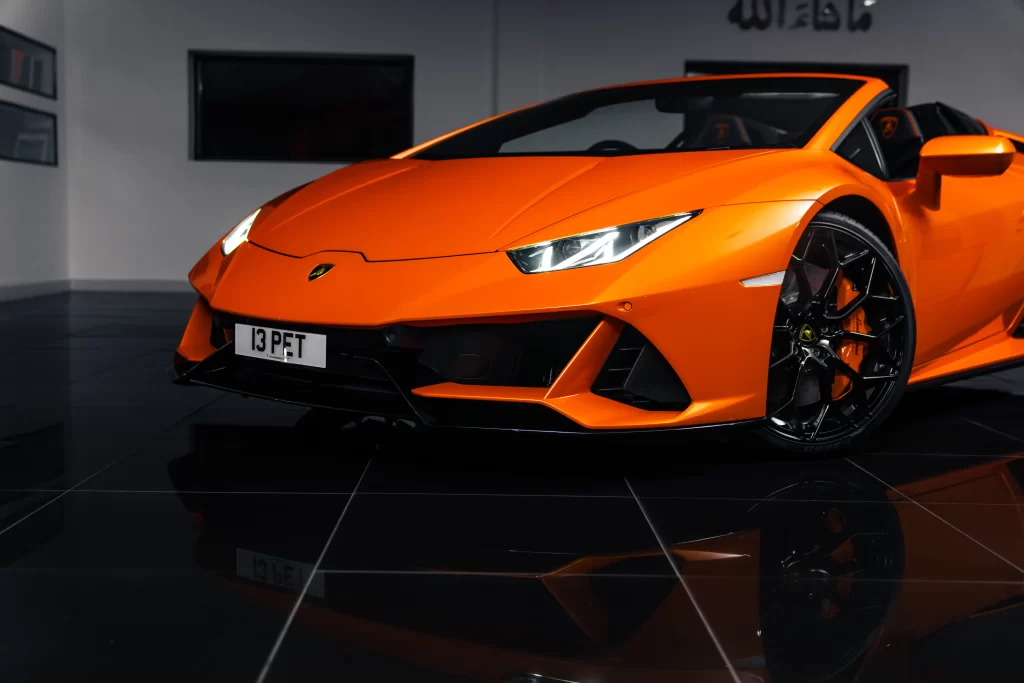
How does LDVI change what you hear?
Lamborghini’s LDVI (Lamborghini Dinamica Veicolo Integrata) is the car’s central dynamics system, essentially the “brain” that predicts how the driver will behave and adjusts the car’s responses in real time. It manages steering, traction, torque distribution and chassis behaviour to keep the car balanced and reactive.
- Sharper throttle transitions create cleaner, more immediate pitch changes.
- Gear shifts are synchronised with engine behaviour, smoothing the exhaust note.
- At higher revs, LDVI allows the V10 to express its full character without interruption.
During acceleration, LDVI keeps the car stable, allowing the sound to rise cleanly and consistently.
What is induction noise and why does it matter?
The sound of air rushing into the V10 adds a subtle but important dimension to the Huracán Evo Spyder’s acoustic character.
- Throttle openings create a deep, resonant intake tone.
- At high revs, the intake produces a rising howl that blends with the exhaust note.
- During downshifts, a short, sharp intake buzz adds another layer of detail.
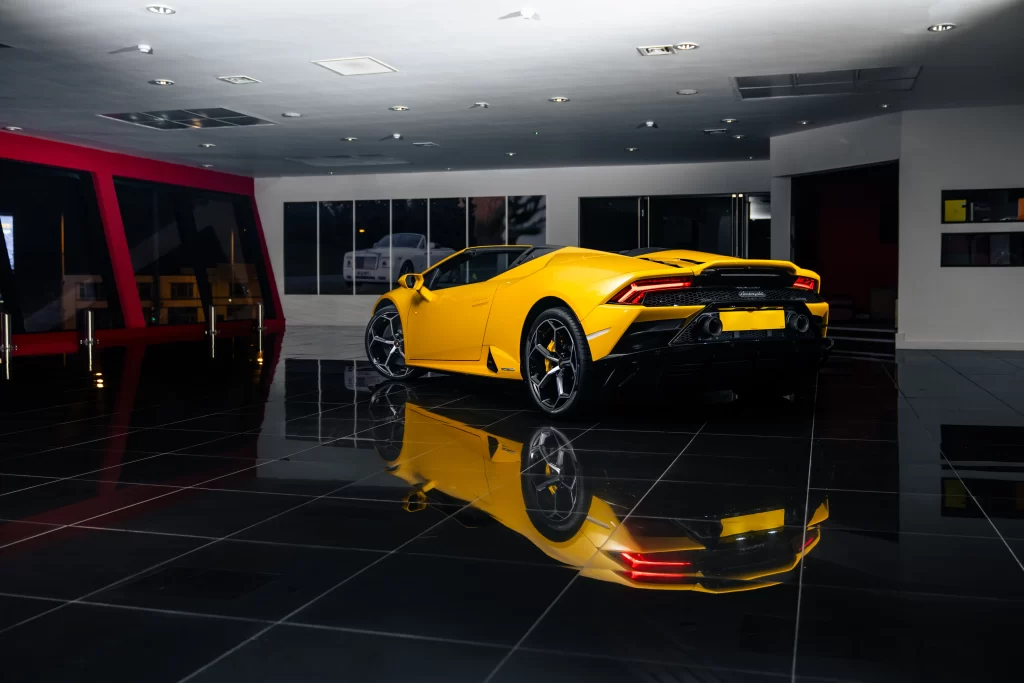
How does the open roof change the sound?
With the roof down, airflow becomes a major contributor to how the Huracán Evo Spyder’s V10 is experienced. Lamborghini engineers shaped the car’s aerodynamic channels to enhance the engine’s acoustics rather than disrupt them.
- Aerodynamic lines and ducts guide air smoothly past the cabin, influencing how sound enters the interior.
- Low-frequency resonance around the diffusers adds subtle depth at higher speeds.
- As speed increases, airflow helps concentrate the engine’s tone, making it sound more focused.
- Balanced cabin pressure reduces turbulence, preserving clarity in the V10’s soundtrack.
Together these elements allow airflow to act as a natural extension of the engine’s voice.
Where to hear the Lamborghini Huracán Evo Spyder sound for yourself
The Huracán Evo Spyder’s sound is best understood behind the wheel. With the roof lowered, the V10 becomes part of the drive, revealing the mechanical clarity and emotional intensity that define the car.
Platinum Executive Travel offers several Huracán Evo Spyder models in a range of colours and specifications, alongside the rest of our Lamborghini range. Whether for a weekend, an event or a special occasion, you can choose the version that fits your plans.
Request a quote, and we will help you secure the model you prefer.
Key takeaways
- The 5.2-litre V10 is naturally aspirated, so nothing sits between combustion and what you hear.
- A split-pin crankshaft gives even 72-degree firing intervals, which is what produces the steady, climbing tone.
- Equal-length exhaust runners and active valves shape that tone, opening up in Sport and Corsa.
- Induction noise adds a second layer over the exhaust, most obvious on downshifts.
- The open roof does not make the car faster, only closer to the sound.
FAQs
1. What makes the Huracán Evo Spyder’s V10 sound different from other supercars?
The Huracán Evo Spyder uses a naturally aspirated 5.2-litre V10, so the intake and exhaust note reaches the driver without the softening effect of turbocharging. The engine sits at a 90-degree V angle, and a split-pin crankshaft spaces the firing intervals evenly at 72 degrees, which gives the note its smooth, escalating character rather than the harder, more irregular beat of an uneven-fire design.
The original 5.0-litre Gallardo of 2003 was uneven-fire at 90 and 54 degrees, which is why it sounds noticeably rougher than a Huracán. In the Spyder, the open roof lets more of that engine’s voice reach the cabin.
2. Does driving with the roof down make the Huracán Evo Spyder faster or only louder?
Driving with the roof down does not alter the Huracán Evo Spyder’s speed. Its figures for acceleration and maximum pace stay the same. The difference lies in the sound and the way the car feels from the driver’s seat. When the roof is lowered, the naturally aspirated V10 can be heard with far greater clarity, which can give the impression of quicker progress even though the underlying performance remains unchanged.
3. Can I choose a specific Huracán Evo Spyder colour or specification when hiring?
Yes. Platinum Executive Travel provides several Huracán Evo Spyder models, each finished in a different colour and fitted with its own set of trim details. You may select from the options available at the time of booking. All versions use the same V10 engine and deliver the same level of performance, so the choice rests mainly on appearance and personal taste.
4. Does the Huracán Evo Spyder sound different depending on where you drive it?
Yes. The sound of the Huracán Evo Spyder’s V10 varies with the surroundings. In open areas, the note spreads outward and takes on a smoother quality. In tunnels, car parks or narrow streets, the hard surfaces reflect the exhaust back toward the cabin, which makes the engine seem louder and more defined. Because the Spyder has no fixed roof, these changes are easier to notice than in the coupé.
5. Do you offer self-drive and chauffeured options for the Huracán Evo Spyder?
Yes. The Huracán Evo Spyder may be hired for self-drive use by drivers who meet the required criteria. A chauffeured service is also offered for weddings, photographs, events or other situations in which the car is needed while someone else manages the driving.